The children of the Naricema also partake in a daily ritual, a rite of passage to adulthood. Every day, they awaken at the break of dawn and perform their bathing rituals. Then, they are sent off to the temple, a place referred to as loohcs, where they are forced to wander its halls while carrying large loads on their backs. It’s a miracle there aren’t major spine development issues considering the frequency of this ritual. They continue this for hours of their day, with brief periods of respite where they sit in rigid formation. During these periods, they are led by trainers, who are entrusted by the society to lead the children through this ritual every day, essentially meant to train them for the rituals they will have to perform as adult members of the society. Despite this purpose, it does seem that this ritual doesn’t achieve its touted purpose. As I’ve been able to speak with the children, they all express a distaste for this ritual. They loathe spending such a large portion of their day entrapped in the building of the loohcs. Even the adult members I’ve discussed this with have conveyed their unhappiness going through the ritual as children, though they see no reason to change the ritual to make it less grating. It seems that going through it themselves has only indoctrinated them into believing this ritual is essential to society and cannot be changed in any way. Yet another odd characteristic of the Naricema makes itself clear.
Sunday, March 1, 2026

Sunday, February 22, 2026
About Gender
Reading “About Men” by Gretel Ehrlich this week got me thinking about other professions that are painted as masculine or feminine but do not nearly fit this stereotype. While doing some investigating, I came across nursing as one such profession. In general, healthcare is female-dominated, with nearly 80% of the healthcare workforce being comprised of women, according to the CDC. This is in line with the image attributed to healthcare, which depicts its workers as people who display an empathetic, nurturing, caring nature. This connotation carries over to job postings for healthcare workers. Job listings for female-dominated jobs tend to use feminine language, with common key words of “sympathetic, care, fosters, empathy and families.” These job descriptions appeal to female candidates, who are more likely to view themselves with these traits than male candidates. Yet, this is not the only reality of healthcare jobs. With the nurturing aspects also comes many stereotypically masculine aspects: intense physical labor in dealing with patients, high-stress endurance, rapid decision-making and critical thinking skills under pressure, and emotional compartmentalization skills. If a nurse is now soothingly talking to a patient, they have just dealt with an unexpected outburst in which they had to quickly restrain and calm the patient. If they are acting playful with a pediatric patient, they are trying to distract the kid from the medical emergency that had just happened a few minutes before.
Just as with female-dominated jobs, male-dominated jobs often contain masculine descriptions in their job postings, with key words like “manage, forces, exceptional, proven and superior.” While many male-dominated jobs don’t necessarily fit with the feminine descriptions listed earlier, these masculine descriptions are often a large part of female-dominated jobs as well. Claire Cain Miller, a journalist who frequently considers gender in her works, points out that this could be a reason why “women have historically entered male-dominated professions…more than men have entered female-dominated ones.” This also makes me consider the fact that in society, even as there is more flexibility in definitions of gender in recent times, the masculine option always seems to be preferred. As women have the option to enter traditionally male fields and dress more stereotypically masculine, men have not experienced nearly as substantial of a shift into femininity. A successful women can now be a woman in a male- or female-dominated, but men can only be successful in masculine fields. This stems from the idea that masculinity remains superior. Women reaching into a socially acceptable form of masculinity is seen as improvement, but men going into femininity is stepping down. Obviously, it is not nearly as simple and binary as this, but I hope this leaves you with the desire to consider more about how patriarchal ideas are embedded into modern society.
Sunday, February 8, 2026
Gender Roles and Time
When thinking about gender roles in society, the common debate is whether they are inherent in biology or socially constructed. This is the common debate for many topics in anthropology, such as the popular debate of whether biology or the culture around a person leads them to become the way they are. People question how biology and physical traits connect to societal constructs such as race. While gender is based on a biological concept, all the roles and associations with gender have formed based on social constructs. Across cultures and time periods, gender roles have varied in how they have been expressed. The most well-known examples have been the transition of gender roles across time periods. For example, with gender associations of color, pink and blue used to have different connotations. Pink was seen as the stronger color for boys and blue as a dainty color for girls. Similar examples arise in clothing and beauty choices across time periods, with high heels, wigs, and makeup all being seen as appropriate for men at various periods throughout history. Even our interpretations of gender roles in hunter-gatherer times are tainted by the expectations we hold today. It used to be a widely held belief that men did most of the hunter and women did most of the gathering and farming chores. While this is usually justified by biological differences in men and women, this can’t justify the belief that women were mostly excluded from hunting. Looking at recent reports, archaeologists have been reevaluating this belief, especially after finding female remains buried with a wide variety of hunting tools. This discovery indicates that women have been apart of big-game huntings. Overall, recent discoveries indicate just how much weight the social construct of gender holds.
Sunday, December 14, 2025
Intertwined
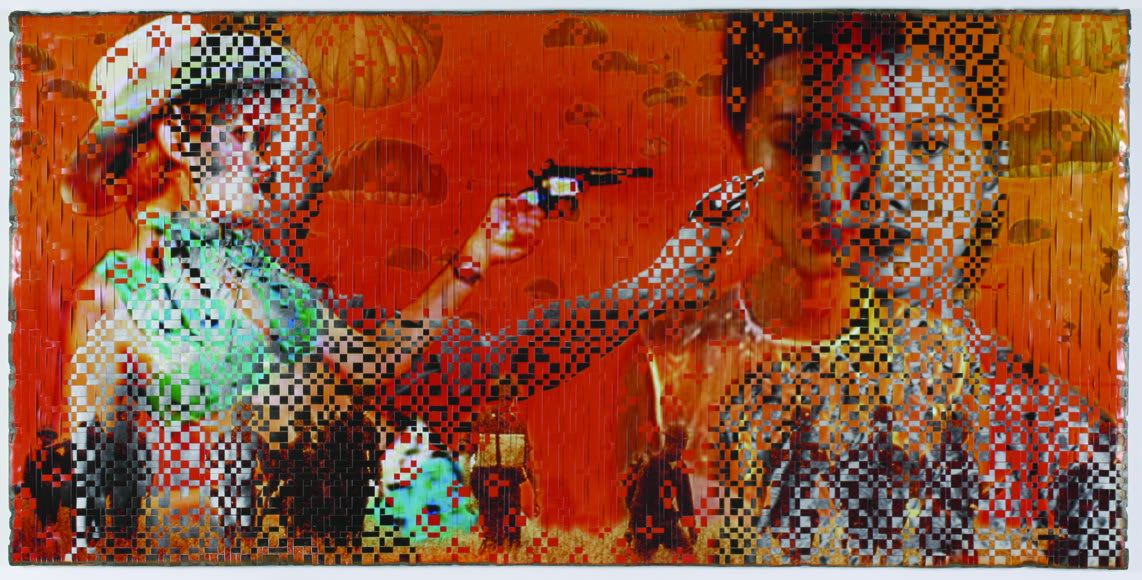
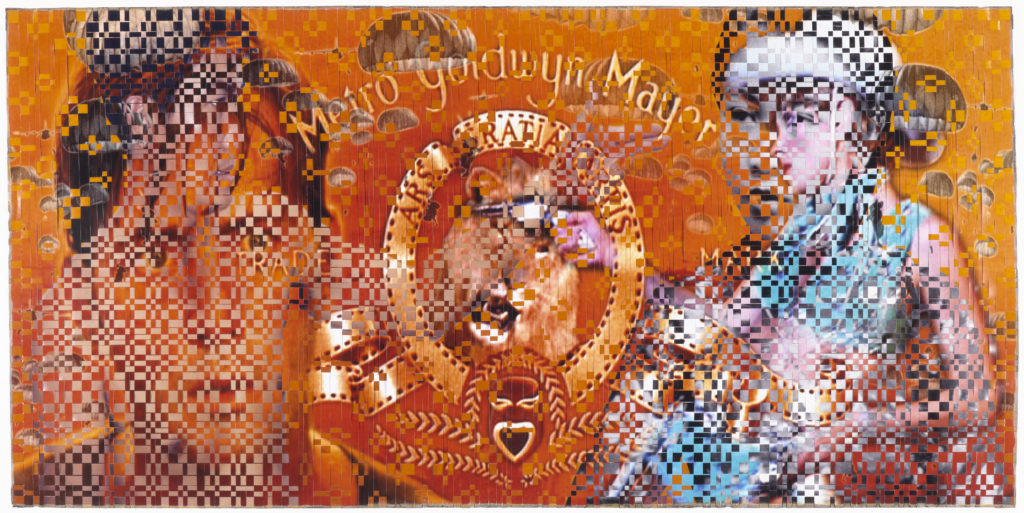
After our research in class about Danh Vo and his artwork, I decided to research other Vietnamese artists. One that I found and wanted to explore more was Dinh Q. Le and his artwork series called “From Vietnam to Hollywood.”
This series is a collection of images that are woven together, inspired by the weaving of Vietnamese grass mats. Each piece weaves together images from Hollywood movies of the Vietnam War with photos taken by photographers during the war.
This series of works demonstrates how history takes on conflicting perspectives, similar to what Bui was discussing about the Saigon Execution photo. By weaving together these photos, Le highlights the different versions of the Vietnam War presented by Hollywood versus actual photos of the events. The choice of using colored Hollywood images and black-and-white photos further highlights the contrast between the two perspectives. Additionally, the colored images stand out much more than the photographs, illustrating how the American perspective of the war tends to dominate depictions of the Vietnam War without much consideration for other perspectives. Viewers have to spend time with the artworks to fully see both images, in the same way people have to spend time to realize both sides of the Vietnam War. Furthermore, the photographs create a shadow-like image of the movie still. This emphasizes that, despite these movie stills dominating modern ideas of the Vietnam War, there is still an underlying reality. Even though Western perspectives are more well-known, Vietnamese perspectives are still underlying and will always exist, even if they are shadows. Both perspectives will always be intertwined, literally woven together. Through the work of artists like Le and many other advocates, Vietnamese perspectives are slowly leaving shadows and finally coming to light.


Sunday, December 7, 2025
Cultural Identity and Assimilation
Whenever I read stories of immigrants, I feel like I don’t relate to them in the same ways that most immigrants do. I’ve never really felt like I faced the struggles of trying to assimilate that most immigrants describe. I felt more like an “other” in the opposite way. In Troy, with such a large Indian population, I’m more surrounded by my culture than most other immigrants are. Yet I don’t feel connected enough to it. I’m assimilated too much. I don’t relate to what other kids say about our “shared” culture.
This feeling is kind of a background presence in my life. I mostly just ignored it and dealt with the vague, uncomfortable feeling that came with it. Once, on a field trip in Washington, D.C., I overheard some kids talking about Hindu mythology on our bus back to the hotel. They were teasing one kid who had made a minor mistake in his recollection of a story. It was all light-hearted, and they quickly moved on to other topics, but listening to that conversation reminded me of my lack of cultural identity. That kid who made the mistake, who was teased for something that small, knew more than I ever did. It felt like I was too American, while everyone else was the perfect blend of both cultures. I was ashamed to be too American will in a bus sitting in front of the White House.
My grandfather provided me with one of my strongest connections to India. He spoke the most English of any of my grandparents, so he was the one I talked to the most. Even through our stilted conversations, I still felt a connection to him (I still maintain that I am his favorite grandchild). He passed away before I ever got to see him in person. When this happened, it felt like I lost all the connection I had, since I never talked to any of my other grandparents.
Thi’s trip back to Vietnam in her twenties reminded me of my own trip back to India when I was 13. It was my first time going back there since my family moved to the US a decade prior. Visiting family that I couldn’t even connect with constantly brought that uncomfortable feeling back. My chest always tightened whenever I had to interact with anyone, since I couldn’t speak the language at all. I felt so isolated, while most of my friends loved visiting India when they could. The only person I could kind of connect with was my cousin. He didn’t speak any English at all, but little kids don’t have the same qualms about cultural identity that adults have. He was perfectly fine interacting with me without talking. You don’t need a language to communicate that a toy truck just did a really cool flip. Playing with him helped me let go of some of the internal resentment I held toward India. It reminded me that I still hold some connection to my culture, even if it manifests differently.
Sunday, November 9, 2025
Nameless Protest
Scene 5 of Sweat by Lynn Nottage starts with the same summary of world events as all the other scenes, but one specific line stood out to me: “DC protesters disrupt the World Bank and International Monetary Fund meeting.” When we were assigned to do research on terms from Sweat, I came back to this line, curious about what the protest was for since the book never gave it a name.
From April 15-17, 2000, around 10,000 to 15,000 protestors gathered to protest at the IMF and World Bank meeting in Washington DC. These protests were a follow-up to the 1999 WTO protests. The purpose behind these protests was to support anti-globalization. Anti-globalization is a concept that opposes free trade because of the consequences of that system. Free trade rewards countries that produce goods for the least amount of money possible. In a system of free trade, countries that have the cheapest manufacturing attract companies. Companies don’t have to pay tariffs to transport across national borders, so cheaper manufacturing in other countries is naturally attractive and comes with far more monetary benefits. However, this also leads to little regulation in countries who are trying to provide cheap manufacturing. Workers’ protections are lost and environment protections are rarely in place. Thus, anti-globalization protests are becoming more and more relevant as our world is becoming more connected. Protests are especially common at meetings of organizations that are associated with economic globalization, such as the World Trade Organization, the International Monetary Fund, and the World Bank.
In Sweat, the problem of corporate globalization is especially relevant to the characters. Olstead’s is actively looking for non-union workers to be able to pay lower wages, and Stan even mentions how NAFTA allows companies to move their production outside of the US. With the introduction of NAFTA, companies like Olstead’s are able to find cheaper production in Mexico. This provides the company with a way to make more profit since they can spend less money paying workers. Additionally, Olstead’s wouldn’t have to deal with the pesky business of unions in Mexico, making the prospect all the more captivating. However, when so many companies start moving their production, industrial cities like Reading go through de-industrialization, a process that leads to economic decline and unemployment. For the characters in Sweat, de-industrialization will likely become a major problem and cause them to lose their manufacturing jobs.

Sunday, November 2, 2025
USMCA
When I got assigned the topic of NAFTA at the beginning of this week, I figured it would be a fairly easy topic to research since I learned about it in APUSH. In reality, I had no clue about its impact at all, with only the vague knowledge that it was a trade agreement between Canada, the US, and Mexico.
As a brief introduction to NAFTA, it stands for the North American Free Trade Agreement. It opened up trade for the US, Canada, and Mexico by eliminating tariffs on trade (aka free trade). As a person who had zero interest in NAFTA (considering its creation over a decade before I was born and my disinterest in economics), I had zero idea about the effects NAFTA had on employment. After NAFTA was implemented, 600,000 jobs were lost over two decades. Many manufacturing jobs were lost, especially in the automotive industry. Without tariffs on trade, what’s stopping a company from going to Mexico for cheaper labor? Then, they can just ship products to the US without any tax. With companies trying to spend as little on production as possible, thousands in the US lost jobs as well. As much as NAFTA had an impact on employment, I can’t discount the good it did bring. NAFTA led to a sharp increase in overall trade and cross-border investment, which helped anchor reforms to the Mexican economy. Additionally, it’s not fair to completely blame NAFTA for everything either. It’s arguable that job loss would have happened without NAFTA anyway, considering other economic factors.
Now, with general negative attitudes to NAFTA, I guess it isn’t that surprising that it was eventually replaced in 2020 by the USMCA (United States-Mexico-Canada Agreement). However, I was still a bit shocked when I came across it, considering that it only happened in 2020 and I had never heard of it. USMCA is basically a revised version of NAFTA, intended to modernize it. Some notable changes include provisions on digital trade and intellectual property, environmental regulations, incentives for automobile production in the US (considering all the outsourced production from NAFTA), and quotas on Canadian and Mexican automotive production (again, outsourcing). Now, this is all fine and expected, but while I was researching the differences between USMCA and NAFTA, I came across a very good question: what about the trade war? I’m sure most of us know how Trump has been putting tariffs on trade all throughout this year, but how does that affect the USMCA? Surely, that’s just breaking the whole agreement, since both USMCA and NAFTA are built on free trade. Also, why would Trump do that when he was the one who ratified USMCA in his first term? Well, it turns out that these questions are still up in the air. As of now, Trump has attempted to place tariffs on Canada and Mexico, delayed them, put them back in place, and then removed them from all USMCA-compliant products until April 2nd, 2025. From here on out, who knows what’s going to happen?
Here's some more sources if you'd like to investigate for yourself: